
How Much Does It Cost to Build a Storage Unit Building in NYC in 2026?
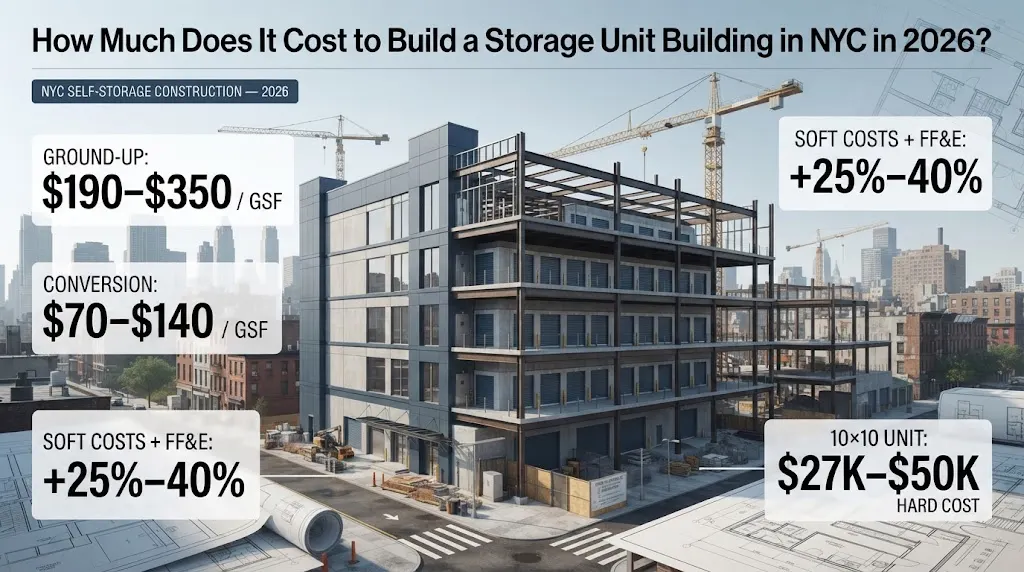
Building self-storage in New York City costs more than almost anywhere else in the world, from $190 to $350 per gross square foot (GSF) in hard cost. Still, owners keep building, because NYC storage rents stay far above national levels. For contractors, that means large bids with very little room for error.
This guide covers building types, trade costs, labor, codes, zoning, tariffs, and a sample estimate.
Key Takeaways
- Conversions of existing NYC buildings typically land between $70 and $140 per GSF.
- Soft costs and FF&E usually add 25% to 40% on top of hard costs.
- Steel tariffs and rising escalation are squeezing fixed-price bids in 2026.
- Local Law 97, Industrial Business Zone rules, and the Scaffold Law are NYC-only cost drivers.
How Much Does It Cost to Build a Storage Unit Building in NYC in 2026?
A ground-up NYC self-storage building costs about $190 to $350 per gross square foot in hard cost in 2026. Conversions typically run $70 to $140 per GSF. Soft costs and FF&E add another 25% to 40% before land.
That range assumes a multi-story, climate-controlled facility with elevators and full sprinkler coverage.
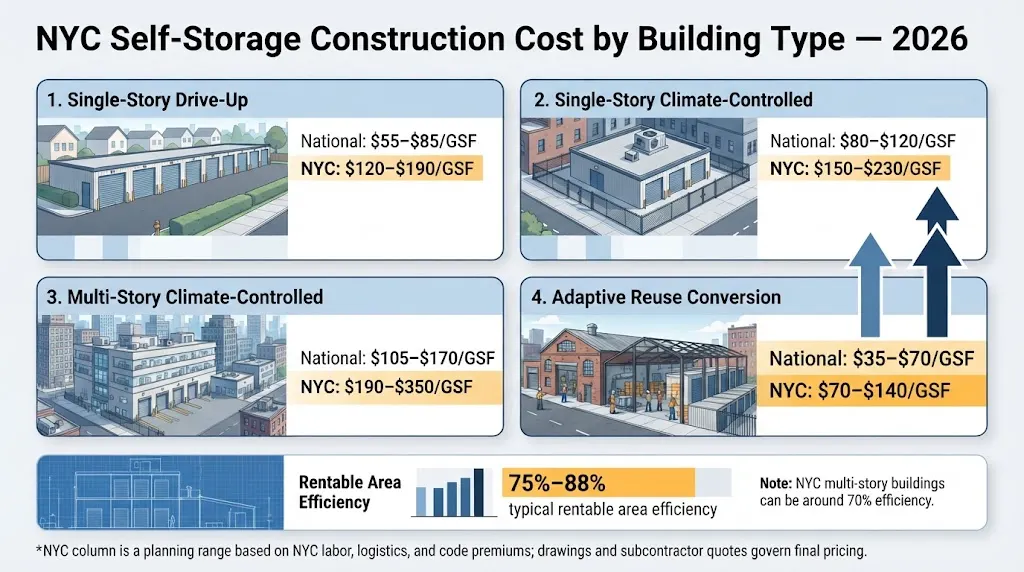
NYC Self-Storage Construction Cost by Building Type
National 2026 benchmarks are a useful starting point. However, New York sits well above them. Even single-story climate-controlled work in the Northeast runs $112 to $152 per GSF.
| Building Type | National Hard Cost ($/GSF) | NYC Planning Range ($/GSF) |
| Single-story drive-up | $55 to $85 | $120 to $190 |
| Single-story climate-controlled | $80 to $120 | $150 to $230 |
| Multi-story climate-controlled | $105 to $170 | $190 to $350 |
| Adaptive reuse conversion | $35 to $70 | $70 to $140 |
We built the NYC column by applying NYC labor, logistics, and code premiums to published benchmarks. Treat it as a planning range. Your drawings and subcontractor quotes will always govern the final number.
Cost per Rentable Square Foot and per Unit
Storage owners think in net rentable square feet (NRSF), not gross. Rentable area usually runs 75% to 88% of gross area. So a $100/GSF building costs about $130 per NRSF at 75% efficiency. In NYC multi-story buildings, efficiency often drops to about 70%. Consequently, one 10×10 unit can carry $27,000 to $50,000 in hard cost.
Pro Tip: Always state your bid basis as GSF or NRSF. Mixing the two can make your number look 30% off.
Why Does Self-Storage Cost More to Build in NYC Than Anywhere Else?
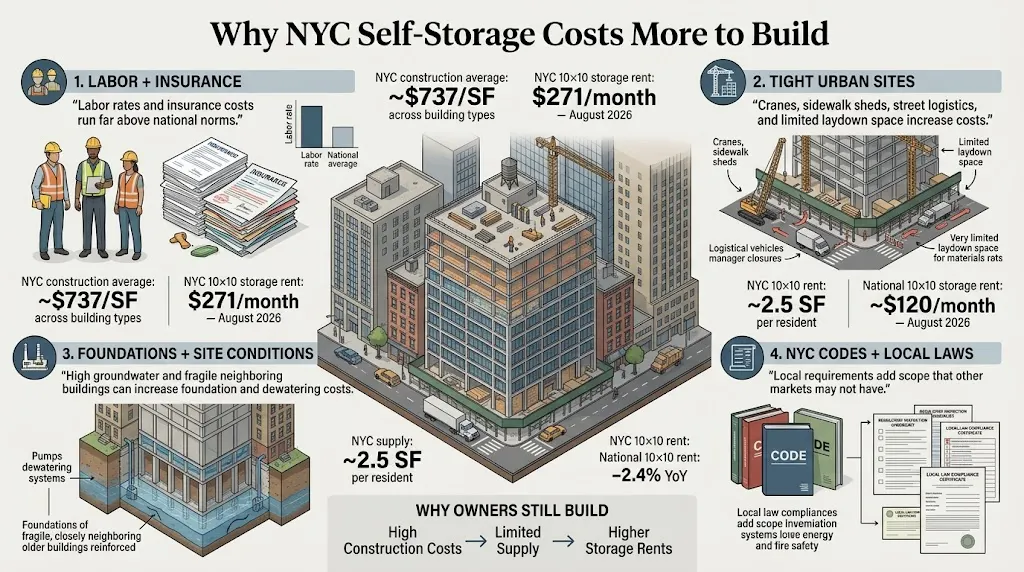
NYC is the most expensive construction market in the world, averaging roughly $737 per square foot across building types. High labor and insurance costs, tight sites, difficult foundations, and strict local laws all push storage budgets higher.
Four Cost Drivers Unique to the Five Boroughs
- First, labor rates and insurance costs run far above national norms.
- Second, tight urban sites create expensive logistics, from cranes to sidewalk sheds.
- Third, foundations often face high groundwater and fragile neighboring buildings.
- Finally, NYC codes and local laws add scope that other markets never see. Each driver gets its own section below.
Why Owners Still Pay NYC Prices
Rents justify the premium. A NYC 10×10 unit averaged $271 per month in August 2026, up 1.5% year over year. Nationally, the same unit fell 2.4% to about $120. Supply is also scarce, at about 2.5 square feet per resident, less than half the national average. Rent data comes from StorageCafe’s NYC market report.
What Type of Storage Building Are You Actually Bidding in NYC?
Most NYC storage bids are multi-story, climate-controlled buildings on tight M-district lots. Conversions of older warehouses are the next most common type. Single-story drive-up projects appear mainly on Staten Island and in the outer Bronx and Queens.
- Multi-story buildings typically rise four to eight stories with elevators, corridors, and conditioned space.
- Conversions save on structure but add demolition, abatement, and retrofit scope.
- Drive-up products, meanwhile, need cheap, flat land.
- RV and boat storage rarely works here. Covered RV storage needs two to three times the site area for similar revenue.
Elevators, stairs, and corridors consume the difference.
Note: Ask the architect for the unit mix schedule early. It drives door counts, partition lengths, and your efficiency math.
How Much Does Each Trade Cost on an NYC Self-Storage Building?
Structural steel, envelope, and general conditions usually carry the largest shares of an NYC storage budget. Together, structure and envelope drive about 35% to 45% of hard cost. The door and security package adds another 4% to 8%.
Now we move from building type to trade-level pricing. This is where bids are won or lost.
Cost Breakdown by CSI Division
The table below shows typical planning splits for a multi-story, climate-controlled NYC storage building. Actual percentages shift with site conditions and structural systems.
| CSI Division / Scope | Typical Share of Hard Cost |
| General conditions and insurance | 10 to 14% |
| Sitework, foundations, dewatering (Div. 31 to 33) | 8 to 12% |
| Concrete (Div. 03) | 9 to 12% |
| Structural steel and deck (Div. 05) | 12 to 16% |
| Envelope and roofing (Div. 07) | 10 to 14% |
| Doors, partitions, specialties (Div. 08, 10) | 7 to 10% |
| Elevators (Div. 14) | 3 to 5% |
| Fire suppression (Div. 21) | 4 to 6% |
| HVAC (Div. 23) | 8 to 12% |
| Electrical and lighting (Div. 26) | 8 to 11% |
| Security and access control (Div. 28) | 2 to 4% |
| Finishes (Div. 09) | 2 to 4% |
Choosing the Structural System in NYC
Structure and envelope carry the biggest share of the budget. In NYC, fire-rating and adjacency rules often favor steel with concrete decks. Masonry and cast-in-place concrete are also common. Pre-engineered metal buildings, meanwhile, rarely fit dense urban lots.
The Door, Partition, and Security Package
This package is the most overlooked scope in storage bids. It includes doors, access systems, kiosks, cameras, and management software. Always confirm whether the owner buys this package directly.
Elevators and Electrical Service
Multi-story storage depends on reliable vertical transport. Similarly, it depends on adequate power. A multi-story, climate-controlled facility often needs 800A to 1,200A electrical service. Security, kiosks, and 24/7 access all add load. In NYC, utility coordination can take months. Therefore, carry that schedule risk in your bid.
Suggestion: Request freight-rated elevator quotes early. Storage tenants move heavy loads, and lead times can stretch your schedule.
How Do NYC Labor Rates, Union Rules, and Insurance Affect Your Bid?
NYC labor, union requirements, and insurance add a significant premium over national pricing. The Scaffold Law raises liability insurance costs, while prevailing wage may apply when public funding is involved. Site safety rules and urban logistics further increase general conditions.
Union vs. Open-Shop Pricing
Many NYC storage owners accept open-shop or mixed-shop bids. However, some sites and lenders require union labor. So confirm the labor requirement before you price a single trade.
Prevailing Wage Triggers
Prevailing wage applies to public work under New York Labor Law. It can also reach privately owned projects with significant public funding. The NYC Comptroller publishes current prevailing wage schedules.
The Scaffold Law and Liability Insurance
New York Labor Law Sections 240 and 241 create strict liability for gravity-related injuries. As a result, general liability and wrap-up insurance cost more in New York than elsewhere. This premium belongs in your general conditions, not buried in trade pricing.
Site Safety Requirements
Local Law 196 requires Site Safety Training (SST) cards for many NYC construction workers. Larger buildings also require a licensed site safety manager or coordinator. Review current rules on the NYC Department of Buildings website.
General Conditions in NYC
Urban logistics add real cost. Sidewalk sheds, crane permits, and DOT street closures all carry fees and time. Moreover, most NYC sites offer little or no laydown space. That often forces off-hours deliveries and extra handling.
Pro Tip: Price sidewalk shed rental by month, not as a lump sum. Schedule slips turn that line into a major overrun.
Which NYC Building Codes and Local Laws Add Cost to a Storage Project?
Several NYC codes and local laws add scope to storage projects. Key ones include the 2022 Building Code, the Energy Conservation Code, and Local Law 97. Local Laws 92 and 94 also require solar panels or green roofs on many new buildings. LL97 fines reach $268 per metric ton over the emissions cap.
NYC Building Code, Sprinklers, and Fire Ratings
The 2022 NYC Building Code governs new storage construction. Storage occupancies require full sprinkler coverage and rated corridor assemblies. Taller buildings also need standpipes.
NYC Energy Conservation Code
Climate-controlled storage must meet NYC energy code requirements. These cover both the envelope and HVAC systems. Continuous insulation, air barriers, and efficient equipment all raise the first cost. They also lower long-term operating costs for the owner.
Local Law 97 Emissions Limits
The law covers any single building over 25,000 gross square feet. Almost every new NYC storage building crosses that threshold. Owners who exceed their limit pay $268 per metric ton of CO₂e over the cap. Limits then tighten sharply in 2030, 2035, and 2040. By 2050, they will approach near-zero. See the NYC DOB Local Law 97 page for details. Always include or clearly exclude the LL92/94 roof scope too.
Need a Faster, Sharper NYC Storage Bid?
NYC Estimating delivers detailed, CSI-organized estimates and takeoffs for NYC self-storage projects.
Where Can You Build Self-Storage in NYC, and How Does Zoning Affect Cost?
Self-storage now falls under Use Group IX after the 2024 City of Yes zoning update. Inside designated Industrial Business Zones, new storage needs a special permit through ULURP. That review can add months of schedule and escalation risk to your bid.
How Zoning Classifies Self-Storage After City of Yes
NYC rewrote its use rules in 2024. On June 6, 2024, the City Council cut Use Groups from 18 to 10. The new groups use Roman numerals, and Use Group IX covers storage. Read the City of Yes for Economic Opportunity summary from the Department of City Planning.
The Industrial Business Zone (IBZ) Special Permit
In designated IBZ areas, new self-storage requires a special permit through ULURP. As-of-right projects are prohibited there. Exceptions include two zones in the Bronx and two on Staten Island. The Steinway IBZ and part of Jamaica, Queens, are also exempt. Background is available from CityLand.
What Zoning Means for Your Bid
ULURP review can add many months before groundbreaking. Therefore, your bid should address escalation and validity periods clearly. A number priced today may not hold a year from now.
How Much Does It Cost to Convert an Existing NYC Building Into Self-Storage?
Converting an existing NYC building into self-storage typically costs $70 to $140 per GSF in hard cost. Nationally, conversions run $35 to $70 per GSF, about 40% to 60% of ground-up cost. Abatement and structural upgrades add NYC-specific scope.
The Four-Condition Test
Not every building converts well. Strong candidates meet four conditions:
- At least 14 feet of clear height.
- Column spacing of 30 by 30 feet or wider.
- Floor loading of 100 PSF or more.
- Fire suppression that can be upgraded without major demolition.
Miss one condition, and the savings shrink quickly.
NYC Conversion Costs National Guides Miss
Older NYC buildings bring hidden scope. For example:
- Asbestos and lead paint abatement.
- Freight elevator modernization or replacement.
- Structural reinforcement for new unit loads.
- Landmark review in historic districts.
- Certificate of Occupancy amendments through DOB.
Pro Tip: Walk the building with your MEP subs before bid day. Existing conditions drive most conversion change orders.
What Soft Costs and Land Costs Sit on Top of the Construction Bid?
Soft costs typically add 15% to 22% of hard cost to a storage project. On dense NYC infill sites, land often represents 30% to 45% of total project cost. Together, they put strong owner pressure on construction pricing.
Soft Cost Breakdown
Design fees take 5% to 8% of hard cost. Permits and fees take 2% to 5%. Financing takes 3% to 6%, and insurance and bonding take 1% to 2%.
Why Startup Calculators Understate NYC
Some online calculators quote statewide startup totals under $3 million. Those numbers rarely reflect NYC reality. Land alone on a typical NYC storage site can exceed that figure.
How Are Tariffs and 2026 Escalation Changing NYC Storage Bids?
Tariffs and escalation are raising NYC storage bids throughout 2026. Imported steel items face a 50% Section 232 tariff. Meanwhile, national construction costs rose 4.45% year over year as of Q3 2026.
Section 232 Metals Tariffs
As of May 2026, steel-based derivative products face 25%. Steel-containing electrical equipment faces 15%. These rates hit structural steel, metal panels, roll-up doors, and switchgear. Track updates through the Associated General Contractors of America.
The Latest Escalation Data
Cost inflation is also accelerating. A national cost report released September 29, 2026, shows 1.28% inflation for Q3. That is the fastest quarterly rise in two years.
How to Protect Your Bid
AGC recommends adding a price-escalation clause at signing. One option is the ConsensusDocs 200.1 amendment, available at ConsensusDocs. In addition, shorten bid validity periods on steel-heavy scopes.
Suggestion: List steel, doors, and switchgear as separate escalation-sensitive line items. Owners accept clauses more readily when risks are clearly itemized.
What Does a Real NYC Self-Storage Construction Estimate Look Like?
A sample 100,000 GSF, five-story climate-controlled building in the Bronx totals about $30.7 million in hard cost. That equals roughly $307 per GSF or $438 per rentable square foot. Each 10×10 unit carries about $43,800 in construction cost.
Project Assumptions
Assumptions: 100,000 GSF, five stories, climate-controlled, M1 Bronx lot outside designated IBZs, steel frame with IMP envelope, two freight elevators, 70% efficiency (70,000 NRSF).
Division-by-Division Sample Estimate
| Scope | % of Hard Cost | Amount |
| General conditions and insurance | 12% | $3,120,000 |
| Sitework, foundations, dewatering | 10% | $2,600,000 |
| Concrete | 10% | $2,600,000 |
| Structural steel and deck | 14% | $3,640,000 |
| Envelope and roofing | 12% | $3,120,000 |
| Doors, partitions, specialties | 8% | $2,080,000 |
| Elevators (2 cars) | 4% | $1,040,000 |
| Fire suppression | 5% | $1,300,000 |
| HVAC | 10% | $2,600,000 |
| Electrical and lighting | 9% | $2,340,000 |
| Security and access control | 3% | $780,000 |
| Finishes | 3% | $780,000 |
| Subtotal | 100% | $26,000,000 |
| Overhead and profit (8%) | $2,080,000 | |
| Contingency (5%) | $1,404,000 | |
| Escalation allowance (4%) | $1,179,000 | |
| Total hard cost | $30,663,000 |
This sample sits in the upper half of our NYC planning range. That is expected for a Bronx site with dewatering.
Note: This is an illustrative planning estimate. Real bids require full drawings, site data, and current subcontractor quotes.
How Long Does It Take to Permit and Build a Storage Facility in NYC?
Most ground-up NYC storage buildings take 24 to 36 months from design to opening. Construction alone typically runs 12 to 18 months for multi-story facilities. DOB review, ULURP, and utility work add time before and during construction.
Cost is one side of your bid. Schedule, however, is the other.
National Baseline
Nationally, permitting often adds 4 to 9 months before groundbreaking.
NYC Timeline Factors
NYC adds several steps. DOB plan review and filings come first. Next, sites inside designated IBZs face ULURP. Utility service and elevator approvals can also delay turnover.
Schedule Risks That Become Cost
Every delay carries a price. Sidewalk sheds, insurance, and site staff keep billing monthly. Therefore, build realistic durations into your general conditions.
Is New Self-Storage Construction in NYC Slowing or Growing in 2026?
New self-storage construction in NYC is slowing in 2026. NYC’s under-construction supply declined over the past year, and national Q1 starts fell 29%. With fewer projects, estimate accuracy matters more than ever.
The NYC Pipeline
New York is not seeing a building boom right now. Yardi Matrix reports that NYC’s storage pipeline has shrunk over the past year. Detailed updates appear on the Yardi Matrix self-storage report page.
The National Pipeline
The U.S. under-construction pipeline fell 14.5% year over year in Q1 2026. It now stands at 50.26 million NRSF. Yardi forecasts about 52.88 million NRSF of deliveries in 2026. Deliveries then drop to about 45.04 million NRSF in 2027.
What This Means for Bidders
Fewer projects mean more bidders per job. Consequently, estimate accuracy becomes your main competitive edge. The shift toward conversions also favors contractors with renovation experience.
What Scope Gaps and Mistakes Cause NYC Storage Bids to Lose Money?
Most NYC storage bids lose money through missed scope, not bad unit pricing. Common gaps include the door package, access-control wiring, dewatering, sidewalk shed duration, and escalation exclusions. A pre-bid checklist catches most of these items.
The NYC Storage Scope Gap Checklist
- Owner-furnished vs. contractor-furnished door and partition package.
- Kiosk, gate, and access-control rough-in.
- Utility service upgrades and utility company fees.
- Winter conditions and temporary heat.
- Dewatering and groundwater management.
- Underpinning and monitoring of adjacent buildings.
- Sidewalk shed duration beyond the base schedule.
- HVAC changes driven by LL97 compliance.
- Material escalation exclusions.
- Special inspections and testing.
Costly Planning Mistakes to Avoid
Efficiency assumptions often go wrong. Assuming 85% efficiency on multi-story storage can overstate revenue by 12% to 18%. Cheap packages also backfire. Saving $80,000 to $140,000 on doors and security can later cost over $200,000 in service calls.
Quantity Takeoff Checklist for Storage Buildings
Accurate takeoffs start with the unit mix. From there, count doors by size and measure partition linear footage. Next, confirm corridor lengths, lighting counts, and sprinkler heads per floor. Detailed construction takeoff services catch these quantities before bid day.
Pro Tip: Cross-check door counts against the unit mix schedule. Mismatches are among the most common storage bid errors.
How Can a Professional Estimating Service Help You Win NYC Storage Bids?
A professional construction estimating service helps you bid faster and more accurately. It delivers complete takeoffs, CSI-organized estimates, and current NYC labor and material pricing. Local knowledge also catches NYC-only costs that national estimators often miss.
Why Local Knowledge Matters
A strong partner also adds escalation analysis and clear inclusions and exclusions. Sidewalk sheds, Scaffold Law insurance, and LL97-driven specs are good examples. A team that prices NYC work daily knows where these costs hide.
Explore our self-storage estimating services and commercial estimating services to see how this works.
Conclusion: Price NYC Storage Work With Confidence
NYC self-storage construction is expensive, complex, and highly competitive in 2026. Ground-up multi-story buildings run about $190 to $350 per GSF in hard cost. Conversions offer savings but bring hidden existing-condition risks. Meanwhile, tariffs, escalation, LL97, and zoning continue to reshape every bid. The contractors who win will be the ones with the most accurate numbers.
That is exactly where NYC Estimating helps. Our team prices NYC storage, warehouse, and commercial projects every day. We understand borough conditions, local laws, and current material pricing. Consequently, your bids go out complete, competitive, and on time.
Ready to Bid Your Next NYC Storage Project?
Upload your plans to NYC Estimating today. Get a detailed takeoff and estimate built for NYC conditions.
Frequently Asked Questions
How much does climate control add to NYC storage construction?
Climate control adds roughly $20 to $40 per GSF to single-story storage nationally. In NYC, the premium is usually higher. Envelope and energy code requirements drive the extra cost.
What is the LL97 penalty for not filing an emissions report?
Buildings that fail to file their LL97 report pay $0.50 per square foot per month. That penalty is separate from excess-emissions fines.
How much more does a climate-controlled 10×30 unit rent for in NYC?
A standard NYC 10×30 averaged $630 per month in August 2026, versus $707 for climate-controlled. Larger climate-controlled units command the biggest premiums.
Which NYC neighborhoods have the lowest and highest storage rents?
Hunts Point in the Bronx averaged $119 per month across all unit sizes, while Yorkville averaged $546. Rent levels help you judge whether an owner’s budget is realistic.
How much does a freight elevator cost in an NYC storage building?
Plan roughly $350,000 to $600,000 per freight-rated elevator car for a five-stop building. This planning range includes installation, DOB filings, and inspections. Actual quotes vary with capacity, speed, and lead time.
How much new storage space will the U.S. deliver in 2028?
Yardi Matrix forecasts about 38.62 million NRSF of new supply in 2028. It expects new supply to bottom out that year at roughly 1.72% of existing stock.
Do M/WBE goals apply to private NYC storage projects?
M/WBE goals generally apply only when public funds, city land, or city contracts are involved. Purely private projects usually do not carry them. Always check the owner’s financing terms.
What bid validity period should NYC storage contractors use in 2026?
Many contractors now limit bid validity to 30 days on steel-heavy scopes. Longer periods should include a clear escalation clause.


