Cost to Frame a 12×12 Room in NYC

How Much Does It Cost to Frame a 12×12 Room in NYC in 2026?

Framing a 12×12 room in NYC costs about $640 to $2,160 for framing only in 2026. Add $210 to $310 for each door opening. That range covers two to four new walls, ceilings from 8 to 10 feet, and open-shop labor. By contrast, prevailing-wage co-op work runs far higher, near $4,450 in the worked example below.

Framing a 12×12 room looks like a small line on a bid. However, NYC turns that line into a real gamble. Stud type, union rates, and building rules all move the price. Therefore, this guide gives GCs and subs a bid-ready framework.

First, you will see the cost range. Next, you will see the takeoff, labor, materials, permits, and hidden costs behind it. Finally, you will get a checklist for your next NYC bid.

What Is the Average Cost to Frame a 12×12 Room in NYC in 2026?

Most open-shop NYC framing bids for a 12×12 room land between $640 and $2,160 in 2026, before door openings. Wood framing runs about $1.96 to $3.91 per square foot of wall in NYC. Metal framing runs about $3.04 to $5.00.

Nationally, HomeGuide puts framing alone at $11 to $32 per linear foot. Wood runs $11 to $25, while metal runs $17 to $32. NYC costs more. Angi’s July 2026 data prices NYC interior wall framing at $10 to $15 per square foot. By comparison, Angi’s national range is $7 to $12. That puts NYC roughly 25% to 43% above the national average.

How Does Cost Change by Scenario?

Next, the table shows NYC framing-only costs for five common room types.

Scenario Walls Ceiling Studs Framing-only range
Prewar corner room 2 10 ft Metal $730 to $1,200
Brownstone bedroom 3 9 ft Wood $640 to $1,270
Co-op bedroom 3 10 ft Metal $1,090 to $1,800
Basement room 4 8 ft Wood $750 to $1,500
Commercial office 4 9 ft Metal $1,310 to $2,160

HomeGuide prices each door, window, or pass-through at an extra $150 to $250 nationally. In NYC, each opening runs about $210 to $310. Notably, prevailing wage jobs and rated assemblies can exceed these ranges.

Is Framing Only the Same as a Finished Wall?

No, and this difference misleads many buyers. A finished wall includes framing, drywall, and electrical work. Angi’s 2026 wall guide puts that finished wall at $20 to $30 per linear foot nationally. Therefore, compare like scope with like scope before judging a quote.
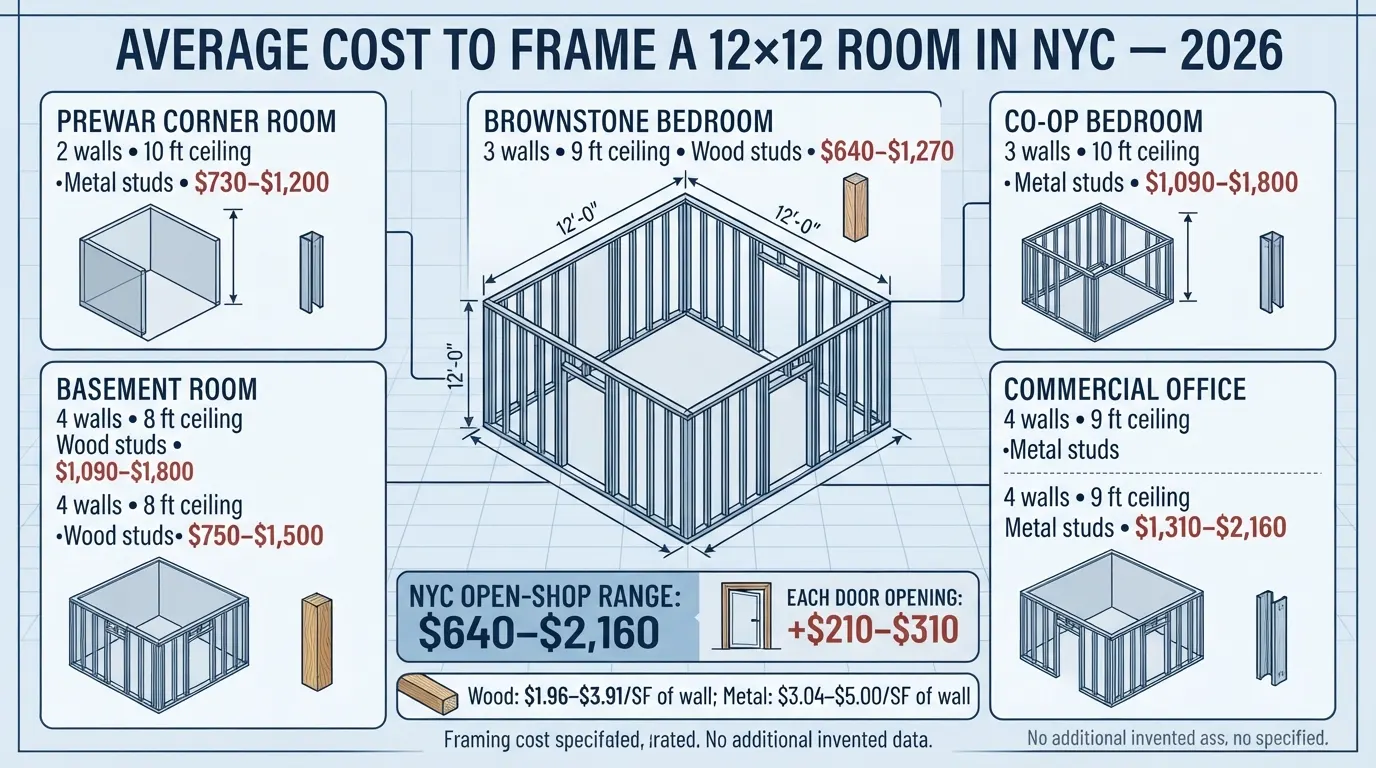
Average Cost to Frame a 12×12 Room in NYC in 2026

Why Is Framing Priced by Wall Area, Not Floor Area?

A 12×12 room has only 144 square feet of floor, yet it needs far more wall. Studs, track, and labor hours follow wall area, which equals linear feet times ceiling height.

HomeAdvisor’s 2026 wall guide measures framing the same way, by wall length times height. Still, many cost guides quote framing per square foot of floor. For example, Angi’s national 2026 range for whole houses is $7 to $16 per square foot. Those figures suit house budgets, but they mislead on a single room. Because a small room has a high wall-to-floor ratio, floor-based rates understate the work.

Ceiling height widens that gap in NYC. Prewar buildings, built before 1940, typically have 9 to 12 foot ceilings, per Milton Coste. By contrast, postwar buildings from the 1950s to 1970s usually sit at 8 feet. As a result, the same 12×12 room can need 25% to 50% more wall in a prewar co-op.

How Do You Do a Framing Takeoff for a 12×12 Room?

Count the new walls, multiply by ceiling height, then count studs, plates, headers, and waste. These six steps keep every takeoff consistent.

For larger scopes, professional construction takeoff services cover residential, commercial, and industrial work. Wood-heavy jobs also benefit from expert lumber takeoff services.

Step 1: Count the New Walls

First, decide how many walls you actually build.

  • Four walls equal 48 linear feet.
  • Three walls equal 36.
  • Two walls equal 24.

In NYC apartments, existing masonry or party walls often replace one or two of them. Therefore, pricing all four can overstate wall length by 33% to 100%.

Step 2: Calculate Wall Area

Next, multiply linear feet by ceiling height.

Walls (linear feet) 8 ft 9 ft 10 ft
4 walls (48) 384 sf 432 sf 480 sf
3 walls (36) 288 sf 324 sf 360 sf
2 walls (24) 192 sf 216 sf 240 sf

Step 3: Count Studs

Then, count studs at your chosen spacing.

● Stud Spacing

Studs per wall equal wall length in inches, divided by spacing, plus one. So a 12-foot wall at 16 inches on center takes 10 studs. At 24 inches, the same wall takes 7. HomeAdvisor notes that 16-inch spacing raises material cost about 30% over 24-inch spacing.

● Corners and Door Openings

Corners need extra framing or backing. NYC Building Code Section 2308.5.2 requires three studs at exterior wall corners. However, it allows two studs when approved backing is provided. That shortcut is barred where fire ratings or shear values apply. Meanwhile, door openings add king studs, jack studs, and a header.

Step 4: Add Plates or Track

After studs, add the horizontal members. Wood walls use a bottom plate and a double top plate. So a 36-foot wood run needs 108 linear feet of plate. Metal walls use top and bottom track, so the same run needs 72 feet. With deflection track, studs sit unscrewed at the top. That gap lets the slab above move without cracking the wall.

Step 5: Size Headers and Add Blocking

Next, size the header for the door. Metal headers are usually built from cut track material. Heavier loads call for doubled track or angle iron. Also, plan blocking early. HomeGuide notes that blocking is required on walls taller than 10 feet. It is also used to anchor handrails and cabinets. Skipping it means cutting open finished walls later.

Step 6: Apply Waste and Fasteners

Finally, add waste for cuts and damage. Small rooms with many short cuts need more waste than long straight runs. A 10% allowance is a common starting point. Then add screws, nails, and anchors to the material list.
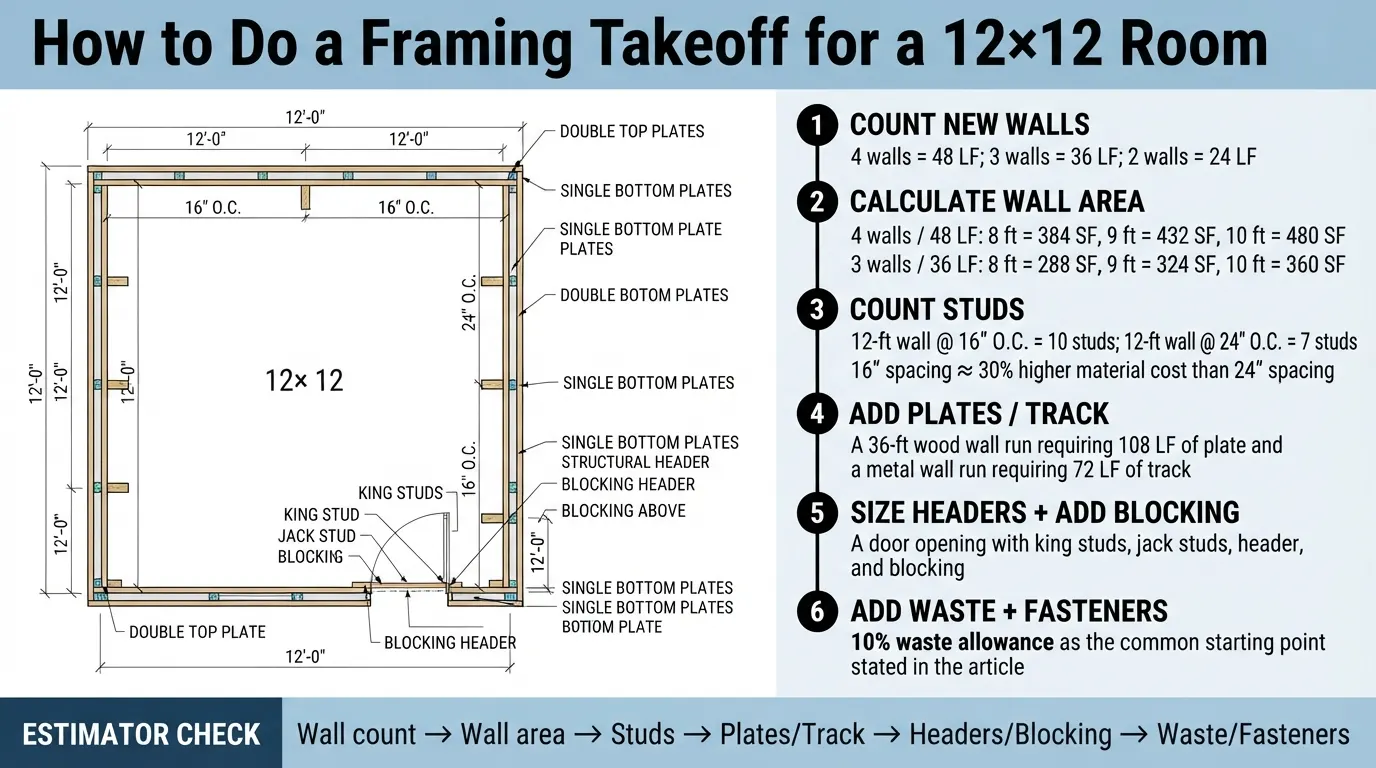
Framing Takeoff for a 12×12 Room

Should You Price Wood Studs or Metal Studs for a 12×12 Room in NYC?

In most NYC apartment buildings, price metal studs. NYC Building Code Chapter 6 requires noncombustible materials in Type I and Type II construction. Moreover, co-op and condo alteration agreements can add rules stricter than the code.

How Does Construction Type Decide the Material?

NYC classifies every building by construction type. Type I is the most fire resistant. Type V allows combustible materials throughout. However, Chapter 6 bars Type V construction inside fire districts, except as Appendix D allows. Therefore, the building’s classification sets your baseline before any preference does.

When Is Wood Allowed?

Wood interior framing is typically allowed in Type III and Type V buildings. Type III pairs noncombustible exterior walls with interiors of any permitted material. Many brownstones and townhouses fit that profile, with masonry exteriors and wood interiors. Even then, read the alteration agreement first. It can require steel even where code allows wood.

What About Fire-Retardant-Treated Wood?

Chapter 6 allows fire-retardant-treated wood for nonbearing interior partitions rated one hour or less. However, public corridors and exits must remain noncombustible. Additionally, non-standard assemblies can draw extra questions at DOB inspection. Consequently, price it only after the building confirms acceptance.

Which Metal Gauge Should You Price?

Wall use and height decide gauge. HomeGuide lists 20, 22, and 25 gauge for interior nonbearing walls. It reserves 14, 16, and 18 gauge for exterior or load-bearing walls. Taller walls move toward heavier gauge. Therefore, confirm gauge against the stud maker’s limiting height tables.

Pro tip: Read the alteration agreement before you open a spreadsheet. It decides the stud type, and the stud type decides the price.

What Are NYC Carpenter Labor Rates for Framing in 2026?

Public work in NYC carries a $60.05 hourly wage plus $50.83 in supplemental benefits for building commercial carpenters. The Comptroller’s schedule runs from July 1, 2026 to June 30, 2027. Combined, the package equals $110.88 per hour before burden.

Overtime runs at time and a half after 8 hours and on Saturdays. Therefore, tight building hours can raise labor cost quickly. The Comptroller also publishes schedule changes on its wage schedules page, so confirm the current version before bidding.

Prevailing Wage or Private Rates?

Prevailing wage applies to NYC public work contracts. Private residential jobs often use lower open-shop rates. For reference, HomeGuide puts national wood framing labor at $7 to $13 per linear foot. Consequently, confirm which rate governs before pricing.

How Long Does a 12×12 Room Take?

HomeGuide puts framing one interior wall at 2 to 6 hours. So a three-wall room needs roughly 6 to 18 man-hours. In NYC, hoisting, protection, and cleanup push that toward the top. Therefore, bid at least one two-person day.

What Does the Labor Build-Up Look Like?

Consider 16 to 32 man-hours at the $110.88 package. That equals roughly $1,774 to $3,548 before burden. Next, add payroll taxes, insurance, and workers’ compensation. After that, add overhead and profit. Finally, set a minimum labor charge, because small jobs still need mobilization, layout, and cleanup.

Pro tip: Never scale a small job down linearly. Fixed setup time does not shrink with the room.

Not sure your framing labor number will hold up?

NYC Estimating prepares takeoffs and labor build-ups around current NYC wage rates and DOB requirements. Most framing estimates arrive within 10 to 48 hours. Send your drawings, and get a number you can bid on.

Get Your Framing Estimate

How Much Do Framing Materials Cost in NYC in 2026?

Lumber futures traded at $532 per thousand board feet on September 28, 2026, per Trading Economics. That is 10.51% below last year. Even so, tariff risk still threatens fixed-price bids.

Physical prices tell a different story. NAHB reports Madison’s framing lumber index at $506.76 on September 25. That index sits 4.5% above last year, while futures sit 10.2% below. Meanwhile, a 10% Section 232 tariff remains in effect. Preliminary antidumping and countervailing duties of 25.9% bring the total on Canadian imports to 35.9%. However, NAHB describes those duty rates as not final. Thus, tariff news can still move prices within weeks.

What Does Wood Framing Material Cost?

HomeGuide puts wood framing materials and equipment at $4 to $17 per linear foot of wall. So a three-wall, 36-foot run needs about $144 to $612 in materials. At the mill level, one 8-foot 2×4 holds 5.33 board feet. At Madison’s September 25 price, that equals about $2.70 of lumber per stud. Retail and yard prices add markup and delivery on top.

What About Metal Studs?

HomeGuide’s metal stud guide prices 25-gauge studs at $0.50 to $1.30 per linear foot. Meanwhile, 20-gauge runs $0.80 to $1.90. So a 10-foot stud costs about $5 to $13 in 25-gauge and $8 to $19 in 20-gauge. HomeGuide also prices a steel-framed interior door opening at $120 to $170. Therefore, request live NYC quotes before bidding.

How Do You Protect a Bid From Price Swings?

First, limit quote validity to 30 days. Second, add an escalation clause for tariff-driven moves. Third, lock supplier pricing when the award is close. Finally, add New York City sales tax on materials, which is 8.875%.

Pro tip: A 30-day price validity clause costs nothing and can save an entire margin.

Do You Need a DOB Permit to Frame a Room in NYC?

Usually yes, because new partitions are typically filed as Alteration Type 2 with the NYC Department of Buildings. A registered architect or professional engineer must file it. Work that changes use, egress, or occupancy needs a heavier filing.

According to PermitPlace, most apartment renovations file as Alt-2. By contrast, Alt-1 applies when a Certificate of Occupancy changes.

What Do 2026 DOB Fees Look Like?

NYC Administrative Code Table 28-112.2 sets every fee, as amended by Local Law 128 of 2024. For co-ops, condos, and other multi-unit buildings, the Alt-2 minimum is $225. On top of that, add $10.30 per $1,000 of work above $3,000. Therefore, a $10,000 framing job carries about $297 in DOB fees. By contrast, a one to three family Alt-2 starts at $130. It then adds $2.60 per $1,000 above $5,000. Fees can rise by department rule, so confirm current figures with the DOB.

Who Files and What Else Adds Time?

An architect or engineer must file the application, and that cost sits outside the fee schedule. Moreover, landmarked buildings may need Landmarks Preservation Commission review. As a result, permit timelines can drive your start date more than crew availability.

What Hidden Costs Do NYC Framing Bids Usually Miss?

Logistics cause most NYC framing losses. Freight elevator time, work-hour limits, insurance certificates, protection, and carting add up quickly. These costs help explain why NYC interior framing runs 25% to 43% above national rates.

  • Work hours: NYC noise rules generally allow construction from 7 a.m. to 6 p.m. on weekdays, per Milton Coste’s co-op guide. However, many co-ops limit work to 9 a.m. to 5 p.m. or even 10 a.m. to 4 p.m.
  • Freight elevator: Most agreements require booked elevator time. Consequently, waiting time becomes billable time.
  • Insurance: Boards require certificates of insurance naming the co-op and managing agent as additional insureds.
  • Protection: Hallways, elevators, and lobbies need covering before materials move.
  • Debris: The alteration agreement sets debris removal procedures, so price carting as its own line.
  • Walk-ups: Carrying studs up narrow stairs adds real labor hours.
  • Board review: The board approves the scope before work starts, so build its timeline into your schedule.
  • Board fees: Many buildings charge alteration review fees and deposits.

Pro tip: Show a separate “building requirements” line on every NYC bid. Then a rule change becomes a change order, not a loss.

When Does a 12×12 Room Need Fire-Rated or Soundproof Walls?

Rated walls apply when the code or the building classifies a new partition as a fire partition. Dwelling unit separations and corridor walls are common examples. Under Section 708.3, fire partitions need at least a 1-hour rating, with an exception for some corridor walls.

Rated assemblies depend on the whole system, not the studs alone. For example, the NYC DOB has accepted assemblies based on UL Design U419. That design uses minimum 25-gauge steel studs at a maximum of 24 inches on center. A 1-hour version carries one layer of 5/8 inch gypsum board on each side. A 2-hour version uses two layers per side. Since board layers drive cost, professional drywall estimating services cover boards, acoustic insulation, and metal studs together.

Sound ratings use STC values. Higher targets call for insulation, resilient channel, and acoustic sealant. HomeGuide prices professional soundproofing at $10 to $30 per square foot installed. Consequently, framing scope grows before any board is hung.

How Does the Cost to Frame a 12×12 Room Vary by NYC Borough?

Manhattan usually costs the most because of high-rise access limits and strict boards. Staten Island and the Bronx usually cost the least. Building type and logistics drive the gap more than distance.

Our NYC construction cost guide shows the pattern at whole-building scale.

Borough 2026 construction cost per sq ft What it means for framing
Manhattan $500 to $1,000+ Mostly gut renovations in steel-framed co-ops and condos
Brooklyn $350 to $600 Brownstone builds run $350 to $500, where wood is often allowed
Queens $220 to $420 Mix of low-rise wood homes and mid-rise steel buildings
Bronx $180 to $380 Similar building mix to Queens, with lower costs
Staten Island $180 to $320 Lowest costs and the most one to three family homes

Therefore, borough context should shape every framing rate you quote.

What Should Contractors Include, Exclude, and Qualify in a Framing Bid?

List scope, exclusions, and assumptions in writing. Clear lines prevent disputes and protect margin.

Include:

●     Wall count

●     Ceiling height

●     Stud type

●     Gauge

●     Spacing

●     Blocking locations

●     Number of openings

Exclude

●     Drywall

●     Electrical

●     Fire-stopping

●     Slab scanning

●     Permits

●     Filings


Qualify

●     Work hours

●     Elevator availability

●     Access route

●     A 30-day material price validity.


For a fuller walkthrough, read our guide on how to write an estimate for construction.

What Does a Complete Estimate Look Like for a Manhattan Co-op Bedroom?

A three-wall, 10-foot, 20-gauge metal room prices near $4,450 at prevailing wage. Labor is the largest line at roughly $2,700.

This example covers 360 square feet of wall and 24 man-hours at the prevailing package.

Line Amount
Labor (24 hours × $110.88) $2,661
Materials (20-gauge studs and track, 10% waste, sales tax) $700
Building requirements (15%) $504
Overhead and profit (15%) $580
Total $4,445

Note: Material prices shift weekly, so confirm that line with a live supplier quote. Also, the DOB filing stays with the owner or GC here.

What Else Do NYC Contractors Ask About Framing a 12×12 Room?

These answers cover questions the sections above do not.

Can a framed 12×12 room legally be a bedroom?

Yes, if it meets the Housing Maintenance Code. Section 27-2074 requires 80 square feet and an 8-foot minimum dimension. A 12×12 room passes on size. However, it also needs a window, light, and ventilation.

Are temporary pressurized walls allowed?

It depends on the building. Many landlords prohibit them, and co-op boards may require approval. If the wall creates a bedroom, that room still needs 80 square feet, a window, and two ways out.

How much does a closet add?

A 6-foot-wide, 24-inch-deep reach-in closet in a corner adds 8 linear feet of partition. At 9 feet high, that is 72 square feet. At the NYC rates above, expect about $140 to $360, plus $210 to $310 for the door.

Is a 10×10 room much cheaper?

Only on wall length. A 10×10 room has 40 linear feet against 48, so about 17% less wall. However, mobilization, protection, filing, and elevator time stay the same. Therefore, the total drops less than 17%.

Who pays for DOB filing?

The owner usually pays, through the architect or engineer who files in DOB NOW: Build. Their design fee sits on top of the DOB fee. Therefore, framing subs should exclude filing costs in writing.

Can you fasten track to a post-tensioned slab?

Only after ground-penetrating radar (GPR) scanning. Post-tensioned slabs hold high-strength steel tendons under heavy force. A scan marks safe fastening zones before any pin or drill enters. Therefore, price the scan and the building’s approval.

Why Should NYC Contractors Get a Professional Framing Estimate?

A professional estimate protects margin where small errors compound. Four mistakes sink most NYC framing bids:

  • Wrong stud type
  • Wrong wall count
  • Missed logistics
  • Stale pricing

Each mistake traces back to weak inputs. For that reason, NYC Estimating builds takeoffs and labor build-ups around current NYC conditions.

Bid your next NYC framing job with confidence.

NYC Estimating delivers detailed takeoffs and labor build-ups for contractors across all five boroughs. Send your plans and get pricing you can defend.
Request a Free Quote

Masonry Work Cost Per Hour

How Much Does Masonry Work Cost Per Hour in NYC?

In September 2026, NYC masonry professionals typically bill $65 to $150 an hour for standard work. Historic restoration ranges from $150 to $250 or more.

That range covers labor only. Materials, permits, and equipment come on top. Here is the quick breakdown by category.

Category NYC Billing Rate
Laborer/Helper $35-$60/hr
Standard Mason $65-$120/hr
Specialist/Restoration Mason $150-$250+/hr
Union Rate, Public Work ~$105/hr (wage + benefits)

Note: The first three rows show rates by skill level. The last row is a different measure: the mandated rate for public projects, regardless of the contractor’s own skill tier.

These are contractor billing rates, not wages. These figures reflect current NYC market conditions as of September 2026, not a national blended average. That range is wide because several factors stack on top of each other.

Why Do Masonry Hourly Rates Vary So Much in NYC?

Six factors drive the spread: experience, project type, borough, material, licensing, and crew size. Each one moves the price independently. Contractors often stack two or three at once.

  • A journeyman mason charges more than a helper.
  • Project type. Repairs cost more than new construction because the scope is unpredictable until a wall opens up.
  • Manhattan and brownstone Brooklyn bill higher than Staten Island.
  • Natural stone costs more to cut and set than brick or block.
  • Licensing and insurance. A licensed, bonded contractor charges for that protection.
  • Crew size. Bigger crews finish faster, but they cost more per hour, total.

A licensed restoration mason on a landmarked Manhattan townhouse sits at nearly every one of these factors at once. That combination is why that job commands the top of the range. Experience sits at the top of that list for a reason. But before ranking masons by skill, it helps to separate two numbers people often confuse.

What’s the Difference Between a Mason’s Wage and NYC’s Billing Rate?

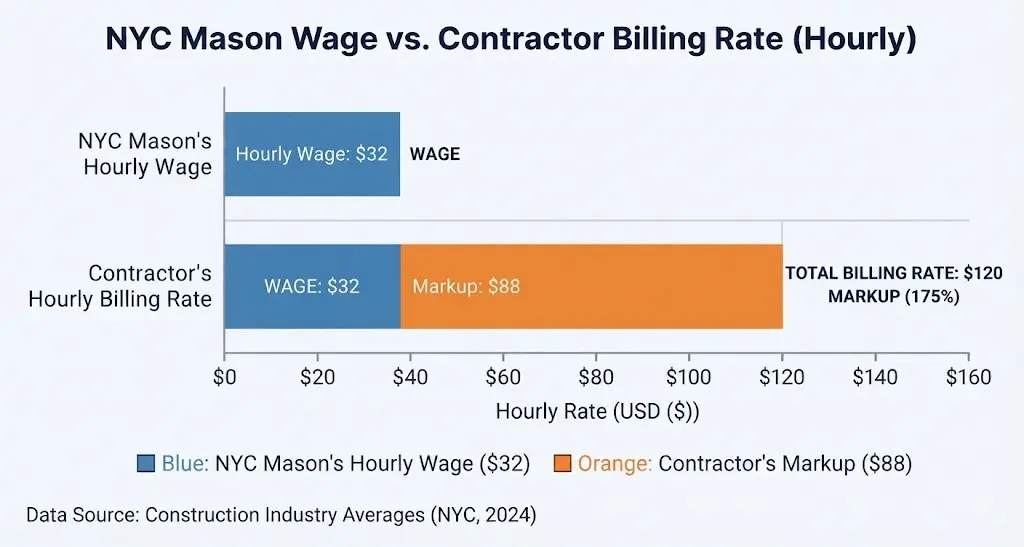
A mason’s wage is what they take home. A contractor’s billing rate covers that wage plus taxes, insurance, tools, and profit.

What Does a Mason Actually Earn?

The Bureau of Labor Statistics reports the national median masonry wage at $58,270 per year as of May 2025. That works out to about $28 an hour. The bottom 10% earned under $19 an hour, and the top 10% earned over $44 an hour.

New York runs higher. Job-posting data from ZipRecruiter puts the New York State average mason salary near $31.82 an hour, above the national figure. That number comes from employer postings, not a government survey. Treat it as a directional estimate, not an exact count. Across all occupations, the New York City metro area’s average hourly wage runs $41.50. That’s well above the $33.54 national average, which helps explain the premium.

What Does a Contractor Actually Bill You?

A contractor’s bill is a different animal. It has to cover payroll tax, workers’ comp, liability insurance, tool depreciation, and vehicle costs. On top of that sits a profit margin, typically 15% to 25%. That’s why a $30-an-hour wage turns into a $65 to $150-an-hour bill.

Wage and rate now make sense. Next, here is what that billing rate looks like by experience level.

NYC Mason Wage VS Contractor billing rate

How Much Do NYC Masons Charge by Experience Level?

Apprentices bill $35-$60/hr; Journeymen bill $65-$120/hr; and Master and restoration specialists bill $150-$250+/hr.

Level What They Do NYC Rate
Apprentice/Helper Mixing, hauling, cleanup, basic prep $35-$60/hr
Journeyman Mason Independent bricklaying, block work, repairs $65-$120/hr
Master/Restoration Specialist Historic brownstone, landmarked facades, custom stone $150-$250+/hr

A journeyman with 10 years of experience commands a premium over someone with 2 years of experience. Restoration specialists charge the most because landmarked work in NYC demands matching historic mortar, brick color, and technique. Getting it wrong on a landmarked building can trigger a Landmarks Preservation Commission (LPC) violation.

Pay differences raise a natural question. Does masonry actually pay well compared to other trades in the city?

How Does Masonry Pay Compare to Other NYC Trades?

Masonry pay in New York beats the national average for the trade and holds up well against related construction roles.

Using statewide job-posting data as a rough guide, masonry work averages about $66,200 per year in New York. That’s above the roughly $60,500 national average for the same trade.

Note: This $60,500 figure comes from job-posting data (ZipRecruiter), a different source and method than the BLS government wage survey cited earlier ($58,270 median). The two numbers won’t match exactly, but both point in the same direction: New York pays above the national average.

Against adjacent trades like landscape foremen or general construction crew roles, masonry pay is competitive rather than exceptional. Skilled, licensed masons tend to earn more than general laborers. Foreman-level roles across trades often outpace entry-level masonry work.

ZipRecruiter’s city-by-city breakdown for New York State usually places New York City itself near the top of that list. That tracks with the borough data above: denser, higher-cost areas pay masons more, in wages and in billing rates alike.

Pay comparisons matter to job seekers and masons alike. Contractors reading this guide have a more practical question: how do these numbers translate into an actual bid?

How Can Contractors Use These Numbers to Price a Winning Bid?

Start with the skill-level table above as a floor-and-ceiling check. If your rate for a standard repair job sits well outside $65 to $120/hr, be ready to explain why, whether that’s specialty material, a landmarked building, or a smaller crew taking longer.

Build your rate the same way the market does: base wage, plus payroll tax and workers’ comp, plus liability insurance, plus tool and vehicle costs, plus a 15% to 25% profit margin. Skipping any one of these is how contractors underbid a job and lose money once it’s underway.

For public work, treat the prevailing wage rate of $105.39/hr in 2026-2027 as your wage-plus-benefits floor under Labor Law 220, not your billing rate. Your bid still needs to layer overhead and margin on top of that number.

Match your rate to the job’s complexity and borough. A landmarked Brooklyn brownstone or a tight Manhattan site justifies pricing at the top of the range. A straightforward Staten Island repair doesn’t.

Getting the hours right matters as much as the rate. An accurate takeoff before you bid, not after, is usually what separates a profitable job from one that eats its own margin.

Pricing is one piece of a winning bid. Where the job is located in the city matters just as much.

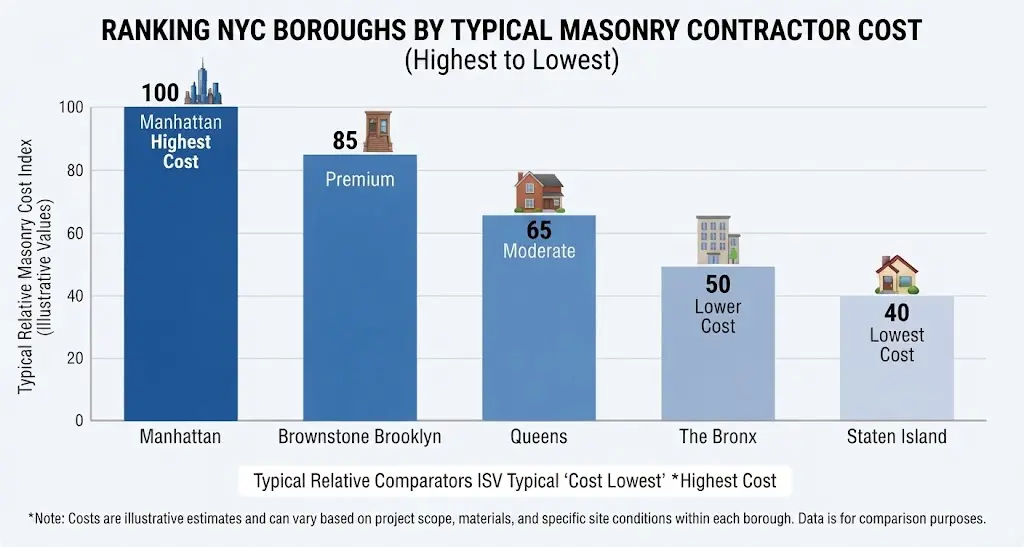
How Does Masonry Cost Vary Across the Five Boroughs?

Manhattan and brownstone Brooklyn bill the highest while Staten Island and eastern Queens run lower.

Borough-level pricing tracks labor access, building stock, and landmark rules.

Area Typical Driver Relative Cost
Manhattan Dense sites, tight staging, high demand Highest
Brownstone Brooklyn (Park Slope, Cobble Hill, Fort Greene) Landmark districts, historic brick Highest
Queens & the Bronx Mixed housing stock, moderate demand Mid-range
Staten Island Easier site access, lower density Lowest

Landmark overlays drive up costs regardless of borough. Brooklyn Heights, Park Slope, and Cobble Hill all carry heavy Landmarks Preservation Commission reviews. That adds both time and fees to a project.

Manhattan’s premium comes from higher labor costs and more complex permitting. Staten Island’s lower cost mostly reflects easier truck access, simpler filings, and more built-in parking near job sites.

Ranking NYC Masonary Contractor Cost

Nationally, the Northeast already bills higher than the national average for masonry work. NYC sits at the top of that regional premium. Prices inside the five boroughs aren’t static, either. They’ve moved noticeably over the past two years.

Have NYC Masonry Prices Changed From 2024 to 2026?

Yes. Contractors report standard billing rates climbing roughly 8% to 12% since 2024, tracking rising material, insurance, and labor costs across the city. NYC’s own public wage data show a smaller but confirmed increase on the labor side alone.

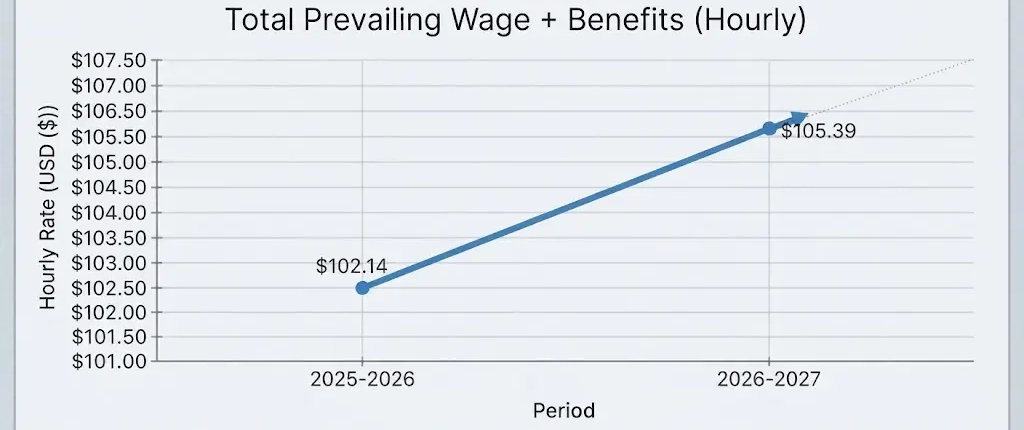
The city’s prevailing wage schedule for bricklayers covers wage plus benefits. It rose from $102.14 an hour in 2025-2026 to $105.39 an hour in 2026-2027, about a 3% increase. That published figure covers only public work. Private billing rates, which also carry overhead and profit margin, have moved more.

Behind the rising rates sits a labor shortage. The BLS projects masonry worker employment will grow just 1% nationally through 2035, slower than most occupations. Even so, roughly 18,400 openings appear each year, mostly from retirements. Fewer new masons entering the trade keeps upward pressure on price.

NYC Bricklayer

Labor cost is only half the story. What you’re building out of changes the number too.

Does the Material You Choose Change the Hourly Rate?

Yes. Natural stone and historic materials cost 25% to 50% more per hour than brick or concrete blocks.

Material Relative Cost
Concrete Block (CMU) Baseline
Clay Brick Baseline to slightly above
Manufactured Stone Veneer Moderate increase
Natural Stone +25-50%
Historic/Custom Stonework Highest

Natural stone takes longer to cut, shape, and set. Historic stonework, common on Manhattan brownstones, demands matching mortar color and joint style. That slows the work further.

Material and skill together set the hourly number. Most homeowners want to know what that means for their specific job.

How Much Does Each Type of Masonry Job Cost Per Hour in NYC?

Repointing runs $50- $75/hr or $10- $30 per square foot. Foundation repair runs $90-$150/hr, higher than the national range.

Job Type NYC Hourly Rate Per Sq Ft (if applicable)
Repointing & Tuckpointing $50-$75/hr $10-$30/sq ft
Foundation & Structural Repair $90-$150/hr –
Brick/Porch/Wall Repair $65-$100/hr $10-$30/sq ft
New Bricklaying/Wall Construction $60-$100/hr –
Chimney Repair or Rebuild $65-$120/hr –
Patio/Walkway Installation Priced per project or per day –

Foundation work costs more in NYC than the national $70-$120/hr range, since access is tighter and permits take longer. Repointing rates closely match the national picture, but full brownstone facades add up fast. A typical three-story front repointing job runs $10,000 to $25,000. A six-story building can run $35,000 to $80,000.

A few drivers stand out. Foundation repair costs more because it often needs excavation and temporary shoring. Chimney work costs more when roof access is difficult. Repointing costs less per hour but adds up over a full facade, since the square footage is large.

Contractors preparing formal bids often lean on construction estimating services to confirm these per-task numbers before submitting a price.

Hourly numbers help with planning, but most owners really want to know the total bill.

What’s the Total Repair Cost, Not Just the Hourly Rate?

Most brick and stone repairs in NYC land between $500 and $3,500. Full facade work runs much higher.

Scope Typical Total Cost
Minor repair (small crack, spot repointing) $500-$2,200
Spalling brick repair $1,000-$3,500
Full facade repointing, 3-story brownstone $10,000-$25,000
Full facade repointing, 6-story building $35,000-$80,000

Nationally, the average masonry repair project runs close to $1,981, according to industry estimating data. Severity drives the range more than anything else. Hairline mortar cracks are cosmetic and cheap to fix. Water infiltration and foundation cracks cost more, since they often signal a deeper structural issue.

Most contractors set a minimum service fee, usually $250 to $500 in NYC. That covers the trip and setup, even for tiny jobs. Bundling small repairs into one visit avoids paying that minimum more than once.

Two pricing numbers now sit on the table: hourly and total. The next question is which model actually protects you as the buyer.

Which Pricing Model Should You Choose: Hourly, Per Square Foot, or Flat Rate?

Flat-rate protects you on defined jobs. Hourly suits open-ended repairs. Per-square-foot works best for large, uniform areas.

Model Best For Risk
Hourly Repairs with unknown scope Cost can run over if problems appear
Per-Square-Foot Large, uniform facades Less flexible for irregular walls
Flat-Rate Small, clearly defined jobs Contractor may pad the estimate upfront

There’s no universally cheaper model. The right choice depends on how well-defined your project is before work starts. Most NYC contractors default to hourly rates for repair work and flat rates for new, well-defined installations. Whichever model you pick, it helps to know exactly what that number is supposed to cover.

What’s Actually Included in a Contractor’s Hourly Rate?

The rate covers wages, payroll taxes, insurance, tools, travel, and profit, not just on-site time.

  • Base wage paid to the mason
  • Payroll tax and workers’ compensation
  • Liability and equipment insurance
  • Tool wear and vehicle costs
  • Business overhead
  • Profit margin, typically 15-25%

That bundle explains why a $30-an-hour wage becomes a $100-an-hour bill. Overhead also covers time spent driving between NYC job sites, which eats more hours than in a spread-out suburb. Labor is covered. A few extra costs tend to catch NYC property owners off guard.

What Hidden or Additional Costs Should You Budget For in NYC?

Permits, materials, equipment rental, and cleanup can add 15% to 25% to the labor bill.

  • DOB permits. The 2026 minimum filing fee is $130. Most alteration permits, once architect and filing fees are included, run $500 to $10,000 or more.
  • Facade and Local Law 11 filings. Budget $500 to $3,000, depending on scope.
  • Materials and delivery. Brick, mortar, and stone pricing shifts with supply.
  • Scaffolding or equipment rental. Add roughly 5% if the contractor doesn’t own the gear.
  • Waste removal. Dumpster rental applies to larger jobs.
  • Minimum trip charges. $250 to $500, even for small repairs.

Suspended scaffold rigs are common on taller Manhattan buildings. They cost more to set up than simple ladders or baker’s scaffolding on a rowhouse job.

Property owners with more than one building often use masonry estimating services to keep the costs of these add-ons predictable. That list can feel long. The good news is several of these costs are within your control.

How Can You Lower Masonry Costs Without Sacrificing Quality?

Bundle repairs, schedule off-peak, and get itemized quotes to cut costs without cutting corners.

  • Use cost-effective materials where the design allows it.
  • Reuse sound existing brick or stone instead of full replacement.
  • Simplify the design. Standard patterns cost less than custom layouts.
  • Schedule during off-peak times, since fall and winter often bring softer pricing.
  • Buy materials in bulk for larger jobs.
  • Do preventive maintenance before small cracks become structural.
  • Handle simple prep yourself, like clearing the work area.

Scheduling around the season is one of the easiest wins on that list, and it deserves a closer look.

Does Masonry Cost Change by Season in NYC?

Yes. Peak season, April through October, runs 10% to 20% higher than the off-season.

Cold weather adds its own complication. Mortar needs temperatures above 40°F to cure properly. Winter jobs often require heated enclosures, which adds cost even when the labor rate itself doesn’t rise.

Booking in late fall or winter, weather permitting, is one of the most reliable ways to save. Contractors sometimes offer off-season discounts just to keep crews busy through the slow months. Season is a cost lever anyone can pull. Union status is bigger and more permanent.

Are Union Masons Worth the Higher Rate in NYC?

On public projects, yes, it’s required. In private work, union labor typically costs 15% to 30% more.

NYC’s current prevailing wage schedule sets bricklayer pay at $60.04 an hour, plus $45.35 in benefits. Combined, that’s a $105.39-an-hour package. That rate applies to public work under Labor Law 220, regardless of the contractor’s own union status.

Prevailing wage rules apply to essentially all public work in New York, regardless of contract size. Private renovations and repairs aren’t covered, which is why rates diverge so much between the two markets.

On private jobs, union masons tend to bill more, but they bring documented training, consistent safety practice, and dependable scheduling. For landmarked or structurally complex work, that reliability often justifies the premium.

Union or not, hiring any professional beats attempting structural masonry yourself.

Is DIY Cheaper Than Hiring a Professional Mason?

DIY saves 60% to 80% on materials. But the repair often lasts only 2 to 3 years, not 10 to 15.

Simple cosmetic touch-ups in a small area are reasonable for a confident homeowner. Structural work is an entirely different risk. A poorly repaired foundation crack or leaning wall can cost far more to fix later than it saved upfront.

Permit rules add another wrinkle. DIY structural work still needs DOB sign-off in most cases. That limits how much you can legally do yourself.

If you decide to hire, it’s important to know how to read the quote.

How Do You Read a Masonry Quote Like a Pro?

Compare the total cost, not just the hourly rate, and confirm exactly what’s included before signing.

  • Never compare hourly rates alone. Compare the full estimated total.
  • Confirm whether materials are included or billed separately.
  • Ask how the contractor prices scope changes discovered mid-job.
  • Verify the contractor’s license, bond, and insurance.
  • Get three written, itemized quotes before deciding.

A quote missing any one of these details is worth a second look before you sign.

General contractors bidding public or large private work in NYC often outsource estimating services. That keeps every line item accurate before a bid goes out. That same discipline helps homeowners spot a lowball quote before it becomes a change-order surprise.

Once you have a real quote in hand, the math behind it is worth understanding too.

How Do You Calculate Total Project Cost From the Hourly Rate?

Multiply hourly rate by estimated hours, then add materials and permit costs.

The formula: (Hourly Rate x Hours) + Materials + Permits and Add-Ons = Total Cost

Example: A Brooklyn brownstone repointing job needs 40 labor hours at $70 an hour. Add $2,500 in materials and a $600 DOB filing fee. That’s $2,800 in labor, $2,500 in materials, and $600 in permits, for a total of nearly $5,900.

For anything beyond a small repair, getting an accurate area measurement matters more than the formula itself. Quantity takeoff services measure every wall, opening, and detail before pricing starts, which keeps the estimated hours number honest.

Need help pricing your next masonry job or preparing a competitive bid?

Contact us for a quote.

FAQs

How long does a typical masonry repair take in NYC?

Small repairs, like spot repointing or a cracked step, usually wrap in 1 to 3 days. A full brownstone facade can take 2 to 6 weeks depending on scaffolding type, weather, and LPC review time.

Does homeowners or co-op insurance cover masonry repairs?

Usually only if the damage stems from a covered event, such as storm damage or a burst pipe. Routine wear, aging mortar, and normal weathering are considered maintenance and typically excluded.

What is Local Law 11 (FISP) and does it apply to my building?

Local Law 11, NYC’s Facade Inspection Safety Program, requires buildings over six stories to have their facades inspected by a licensed engineer every five years. Non-compliance can trigger DOB fines, which is why many facade jobs happen specifically to clear a FISP report.

How do I verify a mason contractor’s license and insurance in NYC?

Check license status through NYC’s Department of Consumer and Worker Protection license search, and ask directly for a certificate of insurance naming you or your building as an additional insured.

What’s a normal deposit or payment schedule for a masonry contractor?

Many NYC contractors ask for 10% to 30% upfront, with the balance tied to milestones such as materials delivered, scaffolding up, and work completed. Be cautious of anyone asking for the full amount before work starts.

Do I need Landmarks Preservation Commission (LPC) approval for my repair?

If your building is in a historic district or is individually landmarked, most exterior masonry work, including repointing, requires LPC sign-off before the DOB issues a permit. Interior work is exempt.

How often should a brownstone facade be inspected?

Beyond the mandatory FISP cycle for taller buildings, low-rise brownstone owners generally benefit from a visual check every 2 to 3 years. Catching hairline cracks early avoids the jump to structural repair pricing.

What happens if masonry damage is left unaddressed?

Small cracks that let water in tend to worsen with each freeze-thaw cycle. A $500 spot repair can turn into a multi-thousand-dollar structural fix within a few seasons.

Bottom Line

So, expect $65 to $150 an hour for standard masonry in NYC, more for restoration. Plus, always compare total cost, not just the rate.

Borough, material, season, and union status all move that number. None of them are secret once you know what to check. Getting an accurate estimate before work starts is still the best way to avoid surprises.

That’s exactly the kind of work NYC Estimating does every day. We build professional construction estimates to help you win bids. That applies whether you’re a homeowner planning a repointing job or a contractor bidding public work.