
How Much Does It Cost to Build a House in New York in 2026?
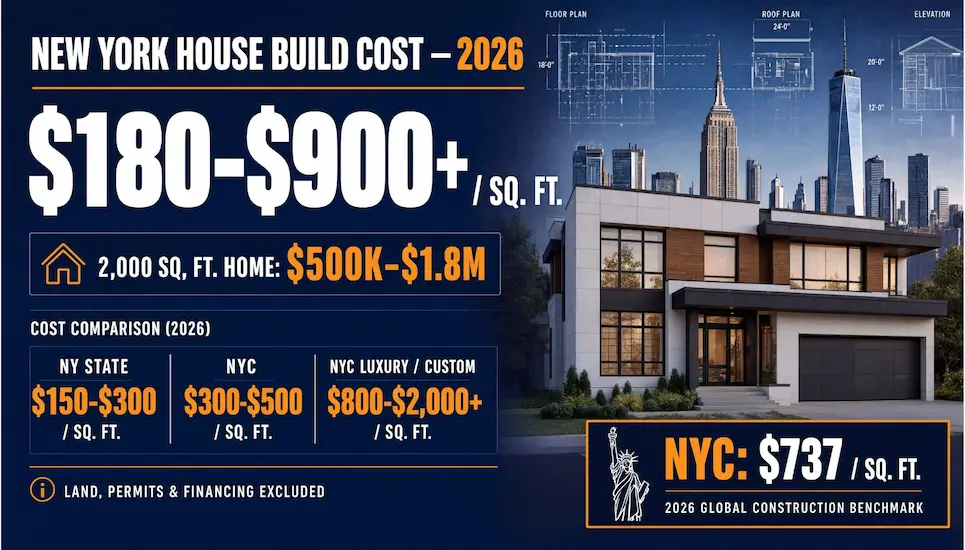
The cost to build a house in New York ranges from $180 to more than $900 per square foot. The detailed cost depends on the borough, with a standard 2,000-square-foot home landing between $500,000 and $1.8 million in hard construction costs before land, permits, or financing enter the picture.
New York City construction now ranks as the most expensive in the world. Turner & Townsend’s 2026 Global Construction Market Intelligence report places New York ahead of Zurich, Geneva, and San Francisco, at an average of $737 per square foot across all building types citywide.
A national cost calculator built around a $120-per-square-foot U.S. average does not apply here, and treating it as a starting point produces budgets that miss reality by six figures. This guide separates land, hard costs, soft costs, permit fees, and financing by borough.
How Much Does It Cost Per Square Foot to Build in NYC?
New York State average to build a house is $150-$300. But you must keep in mind that the average cost does not completely explain hard and soft costs.
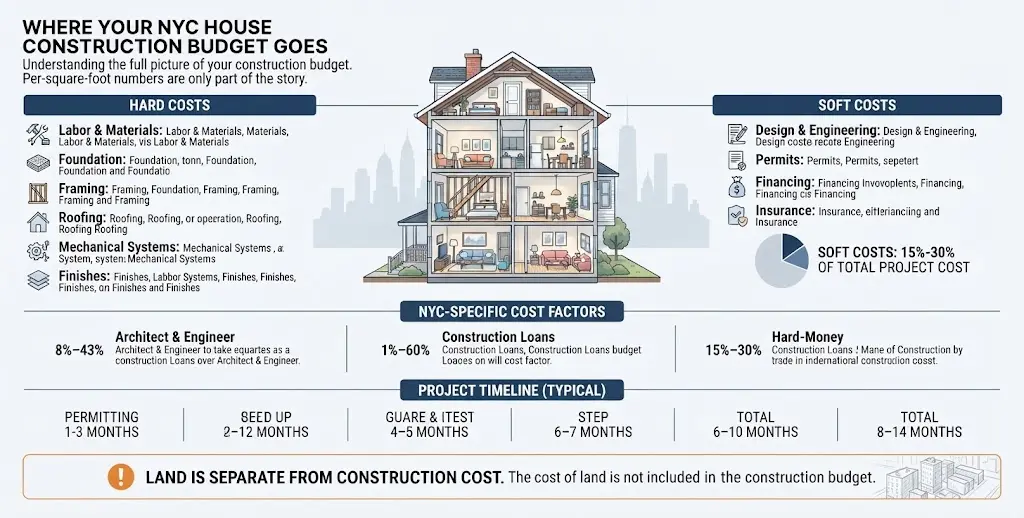
- Hard costs cover labor and materials: foundation, framing, roofing, mechanical systems, and finishes.
- Soft costs cover everything that isn’t physically built into the house: design, permitting, financing, and insurance.
Confusing the two is the single most common budgeting error homeowners make, and it’s the reason a $400,000 quote and a $650,000 quote can describe the identical house.
Pricing splits sharply along one line: New York State as a whole versus New York City specifically. Statewide averages blend low-cost upstate markets like Buffalo and Rochester with five-borough pricing, which drags the headline number down. Isolate the boroughs, and the range moves up substantially.
| Market | Cost Per Sq Ft (2026) | 2,000 Sq Ft Home |
| New York State average (blended) | $150 – $300 | $300,000 – $600,000 |
| New York City average (all boroughs) | $300 – $500 | $600,000 – $1,000,000 |
| NYC luxury / custom finish | $800 – $2,000+ | $1,600,000 – $4,000,000+ |
| Turner & Townsend citywide benchmark, all building types | $737 average | — |
Class of construction matters as much as location. Brownstone-style vertical builds, common across Brooklyn and parts of Manhattan, run $350 to $500 per square foot because three or four narrow floors require more foundation and structural work per usable square foot than a single-story ranch. Cape-style homes, more common upstate and in parts of Staten Island, run $105 to $200 per square foot.
What Does It Cost to Build in Each of the Five Boroughs?
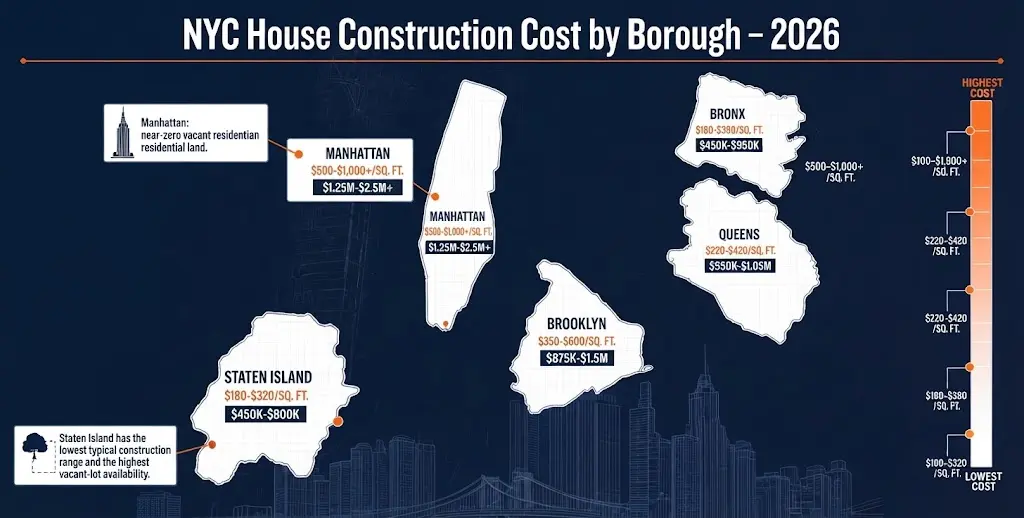
Borough determines cost more than any other single variable in New York City. Land availability, zoning density, and labor logistics shift dramatically across an 8-mile stretch, and a house that costs $700,000 to build in the Bronx can cost $3 million on a comparable Manhattan lot.
| Borough | Construction Cost / Sq Ft | 2,500 Sq Ft Build (Hard Costs) | Vacant Land Availability |
| Manhattan | $500 – $1,000+ | $1.25M – $2.5M+ | Near zero; most projects are gut renovations |
| Brooklyn | $350 – $600 | $875K – $1.5M | Low; concentrated in outer neighborhoods |
| Queens | $220 – $420 | $550K – $1.05M | Moderate; holds roughly 31% of citywide vacant residential lots |
| Bronx | $180 – $380 | $450K – $950K | Moderate; roughly 15% of citywide vacant residential lots |
| Staten Island | $180 – $320 | $450K – $800K | Highest; roughly 33% of citywide vacant residential lots |
Land-availability figures come from PropertyShark’s analysis of the city’s V0 vacant-lot classification, which tracks residentially zoned empty parcels outside lower Manhattan. Manhattan carries effectively none of this inventory, which is why almost no true ground-up single-family construction happens there; nearly every Manhattan “new build” is a gut renovation or a rebuild behind a landmarked facade.
How Much Does Land Cost for a Single-Family Lot in NYC?
Land is the variable competitor content handles worst. Most guides say land “can reach into the millions” and stop there. Actual 2026 listing and closing data tells a sharper story.
| Location | Lot Size | Price (2026) | Zoning / FAR | Price Per Buildable Sq Ft |
| Bushwick, Brooklyn | 1,560 sq ft (19.5′ × 80′) | $1,200,000 | R6, 2.43 FAR | ≈ $317 |
| Sunset Park, Brooklyn | 3,040 sq ft (40′ × 76′) | $990,000 | R5B, 1.35 FAR | ≈ $241 |
| Carroll Gardens, Brooklyn | 5,217 sq ft | $5,250,000 | R6B | $503 (record for the neighborhood) |
The Carroll Gardens transaction, brokered by Marcus & Millichap in April 2026, set a per-buildable-square-foot record for the neighborhood and illustrates a broader pattern: brownstone Brooklyn land now regularly clears $300 to $500 per buildable square foot before a single foundation footing gets poured. Floor Area Ratio, the zoning multiplier that converts lot size into legal buildable area, drives that number as much as neighborhood does. A larger lot with a low FAR can yield less buildable space, and a lower price, than a smaller lot zoned for greater density.
How Have 2026 Tariffs Changed Construction Costs in New York?
Construction takeoff and material costs moved sharply in 2026. A Section 232 tariff regime now applies a 50% duty on steel, aluminum, and copper-heavy products, up from 25% the year before. The Associated Builders and Contractors, analyzing Bureau of Labor Statistics data, found that nonresidential construction input prices rose at a 7.1% annualized rate in January 2026 alone, driven by tariff-affected structural steel, aluminum, and copper wire.
ENR Building Cost Index
The Engineering News-Record Building Cost Index, the industry’s standard material-and-labor benchmark, climbed 4.2% year-over-year through early 2026 on the back of these same duties. The Brookings Institution modeled the broader tariff package and estimated roughly $30 billion in added cost to U.S. residential-structure investment, with about 90% of that burden falling on new construction rather than renovation.
Separately, the Canadian Chamber of Commerce projects that lumber- and metal-related tariffs could add $10,000 to the cost of a typical U.S. home by 2027, since Canada supplies close to 70% of the softwood lumber used in American residential construction.
Lumber, Metal, And Labor Prices
Framing lumber, structural steel connectors, copper wiring and plumbing, and aluminum window and door systems carry the largest exposure. Concrete, drywall, and most interior finish categories carry less, since they rely on domestic supply chains.
Labor adds a second layer of pressure. Current New York construction labor rates run $55 to $80 per hour, up roughly 5.2% year-over-year, reflecting a tight pool of specialized union tradespeople rather than a national trend.
The New York Building Congress projects the statewide construction workforce will reach approximately 578,000 workers by the end of 2026, and demand for licensed electricians, plumbers, and structural trades in the five boroughs continues to outpace that supply, particularly outside peak spring-to-fall building season.
How Does NYC Compare to Other Expensive Cities to Build In?
New York didn’t just rank near the top of the 2026 global construction cost list. It took the top spot outright.
| City | Average Cost / Sq Ft, All Building Types (2026) |
| New York City | $737 |
| San Francisco | Below New York; ranked 2nd–3rd globally |
| Geneva | Below New York; ranked among top 3 globally |
| Zurich | Below New York; ranked among top 5 globally |
| U.S. national average, all building types | ≈ $120 |
Multi-family and renovation work dominate the city’s construction volume far more than new single-family buildings do. The New York Building Congress puts residential floorspace, driven heavily by alteration and renovation activity, at roughly 73% of total construction output citywide. Ground-up single-family construction is a real but comparatively small slice of that market, concentrated almost entirely in Staten Island, Queens, and pockets of the Bronx and Brooklyn.
How Much Do NYC Department of Buildings Permits Cost?
Every new single-family, two-family, or three-family dwelling in New York City requires a New Building permit filed through DOB NOW: Build. The Department of Buildings updated its fee formula effective January 8, 2026, and pushed a further recalculation live on February 2, 2026, that ties several filing categories to reported construction cost rather than flat fees.
| Filing Type | Fee Structure (2026) | Minimum Fee |
| New building, 1-, 2-, or 3-family | $0.06 per sq ft of floor area | $130 |
| New building, under 7 stories / 100,000 sq ft | $0.26 per sq ft | $280 |
| New building, 7+ stories or 100,000+ sq ft | $0.45 per sq ft | $290 |
| Landmarks Preservation Commission review | $50 for the first $25,000 of work, plus $3 per $1,000 above that | $50 |
| Full demolition, record management fee | 1-, 2-, or 3-family: $45; other: $165 | — |
Local Law 128 of 2024 changed payment timing rather than the fee amount: for work resulting in a new or amended Certificate of Occupancy, 50% of the fee is due at filing and the remaining 50% before permit issuance. Projects inside any of the city’s 143 historic districts, or on an individually landmarked lot, require a separate Landmarks Preservation Commission application on top of the standard DOB filing, and that review can add several weeks to the timeline in addition to its own fee.
Does Local Law 97 Apply to a New Single-Family Home?
No. Local Law 97, New York City’s carbon-emissions cap under the Climate Mobilization Act, applies to single buildings of 25,000 square feet or larger, or multiple buildings on one tax lot totaling 50,000 square feet or more. A standard single-family or two-family home falls well under that threshold and carries no LL97 compliance obligation, a distinction several competing guides omit entirely while discussing NYC’s broader climate-code landscape.
What Soft Costs Should You Budget Beyond Land and Construction?
Soft costs run 15% to 30% of total project cost on a typical five-borough build, and New York’s geology and regulatory layers push several line items higher here than almost anywhere else in the country.
Geotechnical survey and rock excavation
Manhattan schist and glacial till across the outer boroughs frequently require blasting or mechanical rock removal, which standard national cost guides don’t price in at all.
ACP-5 asbestos investigation
It is required on nearly all renovation and demolition filings, typically $300 to $800, given the city’s strict asbestos regulations.
Permit expediting
This one is a filing expediter who navigates DOB NOW: Build runs $500 to $1,500 and often shortens approval timelines meaningfully.
Architect and engineer fees
It is typically 8% to 15% of hard construction cost for a custom single-family design, higher for landmarked or FAR-constrained lots.
Sidewalk shed and site protection
Required only when work exceeds 40 feet in height, or 25 feet for partial demolition; the DOB explicitly exempts one- and two-family homes from certain sidewalk-shed penalties in the public right-of-way, so most single-family builds avoid this cost entirely.
Builder’s risk insurance and site security
These risks run higher in dense boroughs where adjacent-property protection plans are required before excavation begins.
What Does a Construction Loan Cost in New York in 2026?
Traditional bank and credit union construction loans carried rates between 6.5% and 9% through 2026, roughly a full point above standard mortgage rates, because the lender is financing a home that doesn’t exist yet. Most run 12 to 18 months, structured as interest-only during the build with payments calculated only on funds actually drawn. Private and hard-money construction lenders, more common for ground-up development sites, charge considerably more, with several 2026 programs pricing between 9% and 14% depending on borrower experience and loan-to-value.
A second closing is often required to convert a construction loan into permanent financing once a Certificate of Occupancy is issued, and that conversion carries its own closing costs, separate from the construction-phase closing.
How Long Does It Take to Build a House in New York City?
| Phase | Typical Duration |
| DOB permitting and plan review | 1 – 3 months |
| Site work, foundation, and framing | 2 – 3 months |
| Mechanical, electrical, and plumbing rough-in | 1 – 2 months |
| Interior and exterior finishes | 2 – 3 months |
| Total, standard project | 8 – 14 months |
| Custom builds, landmarked or FAR-complex lots | 16 – 24 months |
Want Estimate For Your NYC House Project
Planning a new home in New York City? NYC Estimating provides detailed, borough-specific construction estimates based on current 2026 labor costs, material pricing, DOB requirements, and project-specific scope. Get a line-item estimate for your NYC house project before you buy land or break ground, so you can plan your budget with real construction costs.
How Can You Reduce the Cost of Building a House in New York?
- Get a line-item estimate before buying land. A lot’s FAR determines buildable square footage, and buildable square footage determines nearly every downstream cost; pricing the build before closing on land prevents budget overruns discovered mid-project.
- Target Queens, the Bronx, or Staten Island for ground-up construction. These three boroughs hold roughly 79% of the city’s vacant residentially zoned lots combined, according to PropertyShark, and carry construction costs 40% to 60% below Manhattan and brownstone Brooklyn.
- Lock material pricing early. With Section 232 steel and aluminum duties at 50% and lumber tariffs still in flux, a signed materials contract at the start of a project can protect against a mid-build repricing.
- Choose simple massing over complex geometry. A rectangular footprint costs less per square foot to frame, foundation, and roof than an articulated design with multiple wings or rooflines.
- Confirm LL97 non-applicability in writing. Some contractors quote emissions-compliance line items on single-family jobs that fall well under the 25,000-square-foot threshold; verifying scope before signing prevents paying for compliance work the project doesn’t legally need.
- Get a professional cost estimate before bidding out the project. A detailed, line-item estimate for construction, built around actual borough labor rates, current material pricing, and the correct DOB fee schedule, is the single most effective tool for keeping a New York build on budget from permit to final Certificate of Occupancy.
Frequently Asked Questions
Is It Cheaper to Renovate or Build New in NYC?
Renovation is usually cheaper per square foot, since an existing foundation, framing, and utility connections remove several of the costliest line items in a new build. A gut renovation typically runs 20% to 40% below new construction costs for a comparable finish level, though older housing stock across the boroughs frequently triggers ACP-5 asbestos testing and lead-paint remediation that a ground-up build on vacant land avoids.
Do I Need an Architect to Build a House in New York City?
Yes. DOB NOW: Build requires drawings filed by a registered design professional, either a licensed architect or a professional engineer, for any new building permit. Owner-filed plans are not accepted for new one-, two-, or three-family dwelling construction within the five boroughs.
What Is the Cheapest Borough to Build a House In?
Staten Island consistently prices lowest, at $180 to $320 per square foot for standard construction, and holds the largest share of the city’s vacant residentially zoned land. The Bronx runs a close second on both cost and land availability.
The Bottom Line on the Cost to Build a House in New York
The cost to build a house in New York depends less on square footage than on which of the five boroughs, and which zoning lot, the project sits on. A Staten Island build and a Manhattan build separated by twelve miles can carry a $2 million cost gap on an identical floor plan. Tariffs, the February 2026 DOB fee update, and construction loan rates above 6.5% all move the final number in the same direction: up.
Getting an accurate, current, line-by-line estimate before breaking ground, rather than relying on a national average, is what separates a project that finishes on budget from one that doesn’t.
NYC Estimating builds detailed, borough-specific construction estimates for homeowners, developers, and contractors across all five boroughs, incorporating current DOB fee schedules, 2026 material pricing, and real labor rates.


